
Gold Foil Stamping on Packaging: How It Works and When It Is Worth It
Ektta Jain
Founder, RoboSouls •
Executive Summary
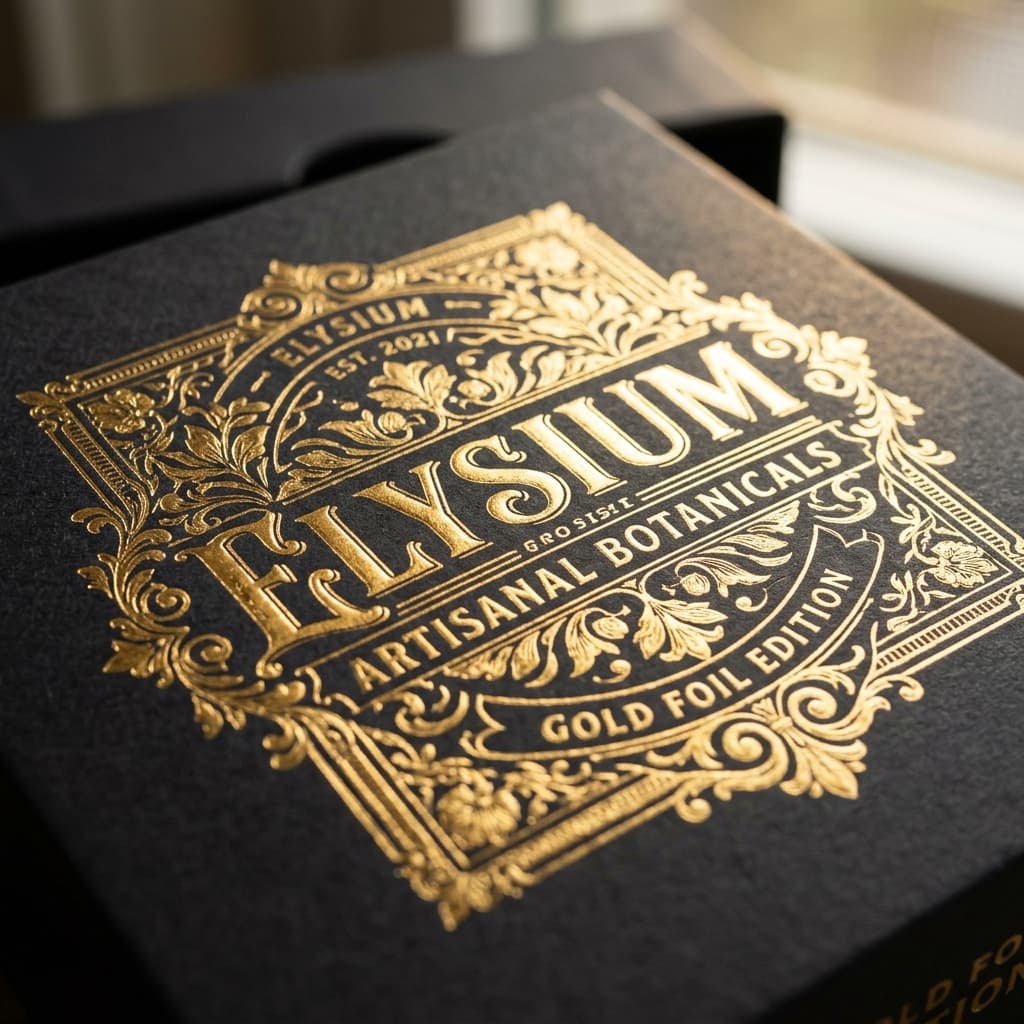
Foil stamping presses a heated metal die against a metallised film so the foil releases onto the substrate only where the die makes contact. Because it applies an actual metallic layer rather than an ink imitating one, it reflects light the way metal does and no CMYK approximation matches it. It needs a physical die per design, reproduces solid shapes far better than gradients, and works best on smooth substrates. Combination dies apply foil and emboss in a single pass.
Key takeaways
- Foil is a metallised film transferred by a heated die, not an ink. That is why it looks like metal and metallic ink does not.
- Every design needs its own die, so foil suits stable artwork and not frequently changing content.
- Solid shapes and clean type stamp well. Fine gradients and very thin strokes do not.
- Smooth substrates release foil cleanly; heavy texture resists it.
- A combination die stamps and embosses at once, which registers perfectly because it is one operation.
1. How Foil Stamping Works
Key Takeaway
A metal die is heated and pressed against a roll of metallised film laid over the substrate. Where the die makes contact, heat and pressure release the foil from its carrier onto the surface.
Foil stamping — also called foil blocking — is a transfer process rather than a printing one. The foil arrives as a roll of polyester carrier film coated with a release layer, a colour or metal layer, and an adhesive layer activated by heat. The die, engraved in magnesium, copper or brass depending on run length and detail, is heated and pressed through the film onto the substrate. The adhesive activates, the release layer lets go, and the metal layer stays behind in exactly the shape of the die. Nothing is printed and no ink is involved, which is the reason the result reflects light like metal: it is a metallised layer sitting on the surface, not a pigment suspended within one.
2. Hot Foil vs Cold Foil
Hot foil is the traditional process described above and remains the standard for premium packaging. It produces the brightest, most reflective result, works on a wide range of substrates including board and textured stocks, and can be combined with embossing. Its constraint is the die: one must be made for each design, which carries a tooling step and makes it uneconomical for artwork that changes frequently. Cold foil applies an adhesive by printing plate, lays foil over it and cures with UV light, needing no heated die. It integrates into a press run, handles fine detail and gradients better, and can be overprinted with process colours to create metallic hues beyond gold and silver. The trade-off is a slightly less brilliant finish and a narrower substrate range. For most rigid box and premium carton work, hot foil is what the brief actually wants.
| Hot foil stamping | Cold foil | |
|---|---|---|
| Mechanism | Heated die presses foil onto substrate | Printed adhesive, foil applied, UV cured |
| Tooling | A die per design | A printing plate, no die |
| Brilliance | Highest | Slightly lower |
| Fine detail and gradients | Limited | Better |
| Substrate range | Wide, including textured board | Narrower, prefers smooth coated |
| Can combine with emboss | Yes, in one pass | No |
| Overprintable for custom colours | No | Yes |
3. The Die, and What It Costs You in Flexibility
The die is the part of the process buyers most often underestimate. It is a physical engraved plate, made specifically for the artwork, and it is why foil is a decision to make early rather than add late. Magnesium dies are the usual choice for shorter runs and straightforward shapes. Brass costs more, holds finer detail and survives far longer, which makes it the sensible option for a mark that will be stamped repeatedly across years of packaging. Because the die encodes the artwork, any change to the design — even a small one — requires a new die. This makes foil an excellent fit for a logo or a fixed brand mark, and a poor fit for anything containing variable content, dates, batch information or seasonal wording.
4. Substrates: What Releases Foil Cleanly
Key Takeaway
Smooth surfaces release foil cleanly. Heavily textured stocks resist it, producing broken coverage where the foil fails to contact the low points of the texture.
Foil transfer depends on the die making even contact across the whole shape, which means surface topography matters. Smooth coated boards and the printed art paper wraps used on rigid boxes take foil extremely well. Uncoated smooth stocks also stamp cleanly and produce a slightly softer edge that some designs prefer. Textured and laid papers are where problems appear: the die contacts the high points of the texture and misses the valleys, so the foil comes out speckled. Sometimes that broken effect is desirable and is specified deliberately, but it should be a choice rather than a surprise. Kraft and brown boards stamp well and the contrast of bright metal against a matte brown surface is one of the more striking combinations available. Laminated surfaces stamp well provided the lamination is compatible — this is worth confirming on a sample rather than assuming.
5. Beyond Gold: The Range of Foils
Gold and silver dominate but the available range is much wider, and choosing outside the obvious is often what makes a design look considered. Foils come in warm and cool golds, several silvers, copper and rose tones, and a range of pigment foils that are matte and opaque rather than metallic — a matte white foil on a black box, for example, produces a crisp opaque mark that printing cannot achieve on a dark substrate. Holographic and pearlescent foils exist and read as considerably less formal. Matte metallic foils are worth knowing about specifically: they give the density of metal without the mirror finish, which suits designs where a bright gold would look ostentatious against the rest of the identity.
- Bright metallics: classic gold, silver, copper, rose gold — maximum reflectivity.
- Matte metallics: metal density without the mirror, more restrained.
- Pigment foils: opaque solid colours, including white on dark substrates.
- Holographic and pearlescent: high impact, informal register.
6. Combining Foil with Embossing
A combination die does both operations at once: the die is sculpted so that it raises the substrate and lays the foil onto the raised surface in a single strike. The advantage over two separate passes is registration — because it is one operation, the foil and the emboss cannot misalign, which they can if stamped and embossed sequentially. The visual result is distinctly different from either alone: the raised edges catch light at angles the flat foil does not, so the mark changes as the box is turned. Combination dies cost more to make and require more careful artwork, since the sculpting has to be described as levels rather than a flat shape, but for a brand mark that will be used for years it is frequently the most effective single finishing decision available.
7. Artwork Rules for Foil
Key Takeaway
Supply the foil as its own layer in a named spot colour set to overprint. Keep strokes above hairline weight, avoid gradients, and pull the shape very slightly inside any printed element beneath it.
Most failed foil stamps trace back to artwork rather than production. The foil shape must be supplied on a separate layer, drawn in a spot colour named for what it is, so it can be output as a die pattern rather than separated onto a printing plate. Within that shape, keep line weights comfortably above hairline: very thin strokes either fail to release or fill in at the edges as the heated die spreads slightly. Gradients cannot be reproduced in hot foil at all, since the foil is either transferred or it is not — there is no partial coverage. Small type needs care, and serif faces with fine hairlines are the most likely to disappoint at small sizes. Where foil sits on top of a printed element, trap it slightly inside the printed edge so normal registration variance does not leave a visible sliver of the print showing around it.
- Foil on its own named spot layer, set to overprint, excluded from process separations.
- No gradients — foil coverage is binary.
- Avoid hairline strokes and very fine serifs at small sizes.
- Trap the foil shape slightly inside any printed element beneath.
- Confirm the substrate and any lamination will release foil cleanly, on a sample.
8. When Foil Is Worth It, and When It Is Not
Foil earns its place when a single element needs to carry the perceived value of the whole piece, and when that element is stable enough to justify a die. A brand mark on a rigid box, a monogram on a presentation folder, an embossed and foiled crest on a case-bound book — these are cases where one small area does a disproportionate amount of work. It stops earning its place when it is applied broadly, because a box covered in foil reads as cheaper rather than more expensive, or when it is applied to content that changes, since each change means new tooling. It is also the wrong choice where the design needs a metallic effect across a photographic image or a gradient — that is a job for cold foil or for a metallic substrate, not for hot stamping.
Summary Overview
Foil stamping buys one thing that printing cannot supply: an actual metal surface that behaves like metal under light. It costs a die, it wants stable artwork, it prefers smooth substrates and it refuses gradients. Used on a single element that carries the identity of the piece — ideally as a combination die that embosses at the same time — it does more for perceived quality than almost any other finishing decision. Used broadly, it does the opposite.
Frequently asked questions
How does gold foil stamping work?
A metal die is heated and pressed against a metallised film laid over the substrate. Heat and pressure activate an adhesive layer and release the foil from its carrier, so the metal layer stays behind in exactly the shape of the die. No ink is involved, which is why the result reflects light like metal.
What is the difference between hot foil and cold foil?
Hot foil uses a heated engraved die and produces the brightest result on the widest range of substrates, but needs a die per design. Cold foil prints an adhesive, applies foil over it and cures with UV — no die required, better with fine detail and gradients, and overprintable for custom metallic colours, but slightly less brilliant.
Is foil stamping better than metallic ink?
For genuine metallic shine, yes. Foil is an actual metallised layer sitting on the surface. Metallic ink contains metallic particles suspended within a printed film, so it reads considerably flatter. Metallic ink does have the advantage of covering large areas and gradients, which foil cannot.
Can foil be stamped on textured paper?
It can, but coverage may break up. The die contacts the high points of the texture and misses the valleys, producing a speckled result. That broken effect is sometimes specified deliberately, but it should be a decision made on a sample rather than discovered on the finished run.
Can foil stamping reproduce gradients?
No. Foil transfer is binary — the foil either releases or it does not, so there is no partial coverage and therefore no gradient. If a design needs a metallic gradient, the routes are cold foil overprinted with process colours, or printing on a metallic substrate.
What is a combination foil and emboss die?
A sculpted die that raises the substrate and lays the foil onto the raised surface in a single strike. Because it is one operation, the foil and the emboss cannot misregister the way they can when stamped and embossed as separate passes. The raised edges catch light at angles flat foil does not.
Technical Consultation
Need specific specifications for your project?
Send us the format, quantity and finish you are considering, and we will come back with a specification and a quote. Production runs to a 72 hour turnaround.