
Magnetic Closure Boxes: Types, Construction, and When Your Brand Actually Needs One
Ektta Jain
Founder, RoboSouls •
Executive Summary
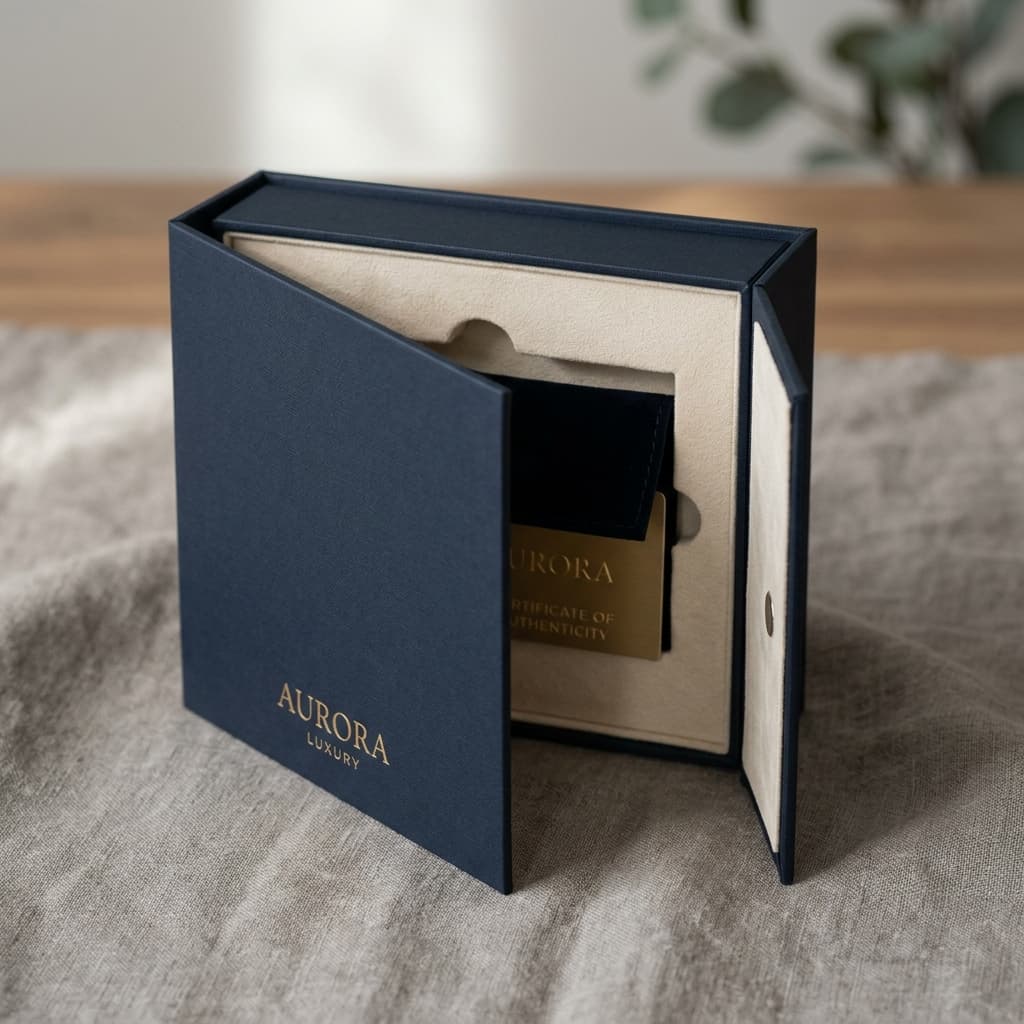
A magnetic closure box is a rigid box with magnets concealed inside the board so the lid closes with a snap and stays shut without a ribbon or clasp. The dominant format is the book-style box, where a hinged flap folds over like a cover and meets magnets in the front wall. Magnets sit in recesses cut into the greyboard before the wrap sheet is applied, so they are invisible from outside. Magnet strength and count are chosen against lid weight and span, not by a fixed rule.
Key takeaways
- Book-style is the most common magnetic construction: a single hinged flap, not a separate lid.
- Magnets are recessed into the board before wrapping, which is why a well-made box shows no sign of them.
- Magnet strength must be matched to lid weight and span. Under-specified magnets on a wide lid produce a lid that drifts open.
- A magnetic box cannot be flat-packed, so it costs more to store and ship than a collapsible alternative.
- Magnets and some product categories do not mix — anything magnetically sensitive needs a different closure.
1. What a Magnetic Closure Box Actually Is
Key Takeaway
A rigid box with magnets concealed inside the board, so the lid snaps shut and holds without ribbon, tuck or clasp. The magnets are never visible on a well-made box.
The magnetic closure box has become the default format for premium presentation packaging, and it is worth understanding what distinguishes it from a rigid box in general. Every magnetic box is a rigid box: greyboard shell, printed wrap sheet, permanent construction. What it adds is a pair of magnets, or several pairs, positioned so that closing the lid brings them into contact and holds it there. The appeal is almost entirely about the moment of opening and closing — the resistance, then the release, then the snap when it shuts again. That tactile event is what buyers are actually purchasing, and it is why the format has spread from luxury goods into corporate kits, electronics and subscription boxes.
2. Book-Style vs Two-Piece Construction
Two constructions dominate, and they behave quite differently in use. The book-style box is a single unit: the lid is a flap hinged along one edge, folding over like the cover of a book, with magnets meeting in the front wall. Nothing detaches, which makes it convenient to open one-handed and impossible to lose the lid. The two-piece magnetic box has a separate lid that lifts off entirely and seats onto the base with magnets around the rim — a more formal presentation, closer to a traditional gift box, and better where the product should be revealed all at once rather than progressively. There are also collapsible magnetic boxes, which fold flat for shipping and are erected at packing; these solve the storage problem but the structure is inherently less solid, and the difference is noticeable in the hand.
| Construction | How it opens | Ships | Best for | Trade-off |
|---|---|---|---|---|
| Book-style (hinged flap) | Folds open like a cover | Assembled | Corporate kits, electronics, subscription | Bulky to store |
| Two-piece (lift-off lid) | Lid removes completely | Assembled | Formal gifting, full-reveal presentation | Lid can be misplaced |
| Collapsible magnetic | Folds open, erects from flat | Flat | High volume, storage-constrained | Less solid in the hand |
| Drawer with magnetic stop | Slides out | Assembled | Sequential reveal, multi-layer sets | More complex to make |
3. How the Magnets Are Concealed
Key Takeaway
Recesses are cut into the greyboard before wrapping. Magnets are seated into them, and the printed wrap sheet passes over the top, hiding them completely.
This is the detail that separates a properly made magnetic box from a poor one, and it is easy to inspect on a sample. In good construction, the recess is cut into the board at the cutting stage, the magnet drops in flush with the board surface, and the wrap sheet is applied over it. The result is a smooth, unbroken surface with no visible outline and no bump under the paper. In cheaper construction, magnets are glued onto the surface of the board and the wrap has to stretch over them, producing a visible raised disc — sometimes felt more than seen, but always present. Run a finger across the closure area of a sample. If you can feel where the magnets are, the recessing step was skipped.
4. Choosing Magnet Strength
There is no single correct magnet specification, and any supplier quoting one without asking about the box is not engaging with the problem. The closing force needed depends on how heavy the lid is, how far it spans without support, and how the box will be handled. A small book-style box with a light flap needs very little. A large lid spanning a wide opening has leverage working against the magnets at the far edge, and needs either stronger magnets or more of them distributed along the closure line. Get this wrong in one direction and the lid drifts open in transit; get it wrong in the other and the box is genuinely difficult to open, which destroys the very moment the closure exists to create. Neodymium is the usual material because it delivers a strong field from a small disc that can be recessed into board without weakening it, but grade and count are selected per design.
- Lid weight: heavier lids need more holding force.
- Span: a wide lid gives leverage to any force trying to lift the far edge.
- Handling: boxes shipped loose need more force than boxes shipped in outer cartons.
- Opening experience: too strong is as much a design failure as too weak.
5. When a Magnetic Closure Is the Wrong Choice
The format is not universally appropriate, and there are cases where it is actively a mistake. Anything magnetically sensitive is the obvious one: some electronic components, magnetic-stripe cards, certain medical devices and some data storage. Even where the risk is small, the perception of risk can be a problem — a customer who believes a magnet damaged their product is a customer complaint regardless of the physics. Cost sensitivity is the second case. Magnets, recessing and the extra assembly labour all add to a unit that already costs more than a folding carton, and if the packaging is going to be discarded immediately the investment goes with it. Storage and freight are the third: magnetic boxes ship assembled and consume volume accordingly. And for very high volumes where packing is automated, a magnetic box that requires hand closing may not suit the line.
6. Design Considerations Specific to Magnetic Boxes
A few decisions come up on every magnetic box project. The closure line is a natural focal point, and putting a foil-stamped or embossed mark near it draws attention to the gesture of opening. The interior deserves as much attention as the exterior, because a book-style box reveals its entire interior in a single motion — a plain grey inside undercuts everything the outside promised. Where a ribbon pull is included, it needs a slot cut at board stage rather than being added later. And on wide lids, a slight thumb notch cut into the front edge makes the box much easier to open without weakening the closure, which is worth considering whenever strong magnets are specified.
7. Inserts: The Half of the Box Buyers Forget
The insert determines what the customer actually sees at the moment the lid lifts, and on a magnetic box that moment is the entire point. An insert can be die-cut board, foam, moulded pulp or a fabric-covered platform, and the choice depends on the weight and fragility of the contents as much as on appearance. Beyond presentation, the insert does structural work: it stops the product moving in transit, which on a rigid box matters more than it might seem, because the box itself does not deform to absorb impact. For multi-item kits, a layered insert that reveals items in sequence turns unboxing into a progression rather than a single reveal, and that is usually worth the additional tooling.
Summary Overview
A magnetic closure box sells one moment: the resistance, the release, the snap. Everything technical about it serves that moment — recessing the magnets so the surface stays clean, matching magnet strength to lid weight and span so opening feels deliberate rather than difficult, and designing the interior so the reveal is worth the gesture. If the packaging will be opened once and discarded, the format is hard to justify. If it will be opened in front of someone whose impression matters, it is difficult to beat.
Frequently asked questions
What is a magnetic closure box?
A rigid box with magnets concealed inside the greyboard so the lid closes with a snap and stays shut without a ribbon or clasp. The magnets sit in recesses cut into the board before the printed wrap sheet is applied, so they are invisible on a well-made box.
What is the difference between a book-style and a two-piece magnetic box?
A book-style box has a hinged flap that folds over like a book cover, with magnets meeting in the front wall — nothing detaches. A two-piece box has a separate lid that lifts off entirely and seats onto the base. Book-style is easier to open one-handed; two-piece gives a more formal, full-reveal presentation.
How do I know if magnets are properly recessed?
Run a finger across the closure area of a sample. On properly made boxes the recess is cut into the board and the magnet sits flush, so the surface is smooth and unbroken. If you can feel a raised disc under the wrap, the magnets were glued to the surface rather than recessed.
What magnet strength does a magnetic box need?
It depends on the weight of the lid, how far it spans unsupported, and how the box will be handled. There is no universal specification. Under-specified magnets let a wide lid drift open in transit; over-specified magnets make the box awkward to open, which defeats the purpose of the closure.
Are magnetic boxes safe for electronics?
It depends on the product. Most modern electronics are unaffected, but magnetic-stripe cards, some data storage and certain components remain sensitive. Where there is any doubt — or any likelihood a customer will believe there is a risk — a different closure is the safer commercial decision.
Can magnetic boxes be shipped flat?
Standard magnetic rigid boxes ship assembled and take up considerable volume in storage and transit. Collapsible magnetic boxes exist and do fold flat, but the structure is inherently less solid and the difference is noticeable when the box is handled.
Technical Consultation
Need specific specifications for your project?
Send us the format, quantity and finish you are considering, and we will come back with a specification and a quote. Production runs to a 72 hour turnaround.