
Spot UV vs Matte vs Soft-Touch Lamination: Which Finish Should Your Packaging Use?
Ektta Jain
Founder, RoboSouls •
Executive Summary
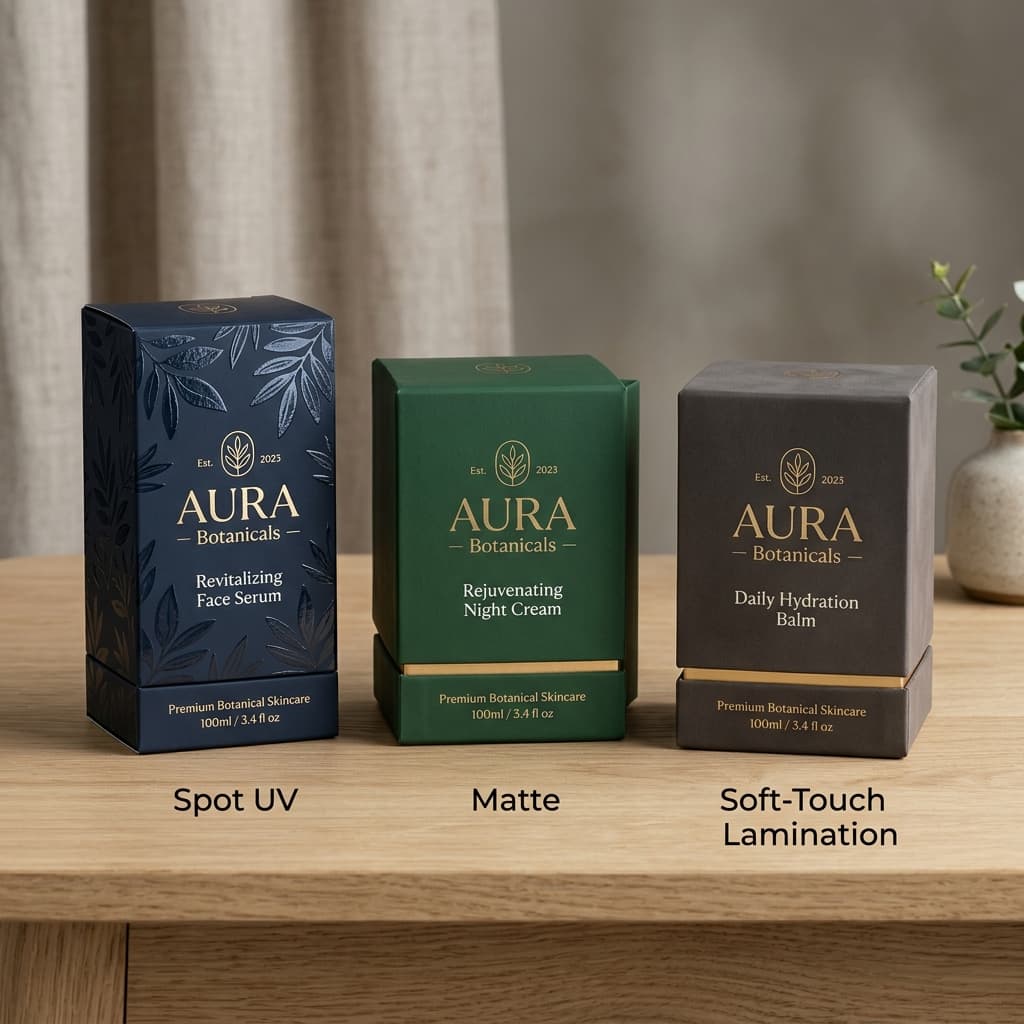
Lamination and coating do two separate jobs: they protect the printed surface and they set its tactile character. Gloss lamination maximises colour depth and scuff resistance. Matte reduces glare and reads as restrained. Soft-touch adds a velvet hand-feel and is the most tactile option, but it also marks most easily. Spot UV, foil stamping, embossing and debossing are contrast effects applied on top of a base finish — they work by differing from what surrounds them, which is why a spot UV logo on a soft-touch matte box reads far more strongly than the same logo on gloss.
Key takeaways
- A finish is two decisions, not one: the base lamination across the whole surface, and any contrast effect applied on top of it.
- Contrast is the mechanism. Spot UV and foil only register because the surrounding area is matte or soft-touch.
- Soft-touch has the strongest hand-feel and the weakest resistance to fingerprints and scuffing. Dark soft-touch surfaces show marks most.
- Embossing and debossing are the only finishes that change the physical shape of the board rather than its surface.
- Every added finishing pass is another trip through a machine, so it extends lead time as well as cost.
1. Coating and Lamination Are Not the Same Thing
Key Takeaway
A coating is a liquid applied and cured on press. A lamination is a plastic film bonded to the sheet under heat and pressure. Lamination is thicker, tougher and changes hand-feel more.
The two terms get used interchangeably in briefs and they should not be. Coatings — aqueous, UV and varnish — are applied as a liquid and cured, adding a thin protective layer with modest change to the feel of the sheet. Laminations are films physically bonded to the surface, which makes them substantially more durable, more water-resistant and far more influential on how the piece feels in the hand. Lamination also stiffens the sheet slightly and, importantly, holds surface fibres together across a fold, which is why heavy dark covers are usually laminated before creasing and folding. The practical difference in a packaging context is that lamination is the default for anything that will be handled repeatedly, and coating is adequate for pieces with a short handling life.
2. Base Finishes Compared
The base finish covers the whole printed surface and sets the character of the piece before any contrast effect is added. Choosing it is mostly a question of what you want the surface to do with light. Gloss reflects it, which deepens dark colours and makes photography look richer. Matte scatters it, which reduces glare, improves legibility of body text and reads as more restrained. Soft-touch is a matte film with a modified surface that produces a distinctly velvet, almost suede texture — it is the finish people notice with their hands rather than their eyes. Each carries a durability trade-off, and the trade-off runs opposite to the tactile appeal.
| Finish | Appearance | Hand-feel | Scuff resistance | Shows fingerprints | Best for |
|---|---|---|---|---|---|
| Gloss lamination | High shine, deepest colour saturation | Slick, smooth | High | Moderate | Photography-led retail packaging, catalogues |
| Matte lamination | Low sheen, softened colour | Smooth, dry | Moderate | Low | Text-heavy covers, restrained premium work |
| Soft-touch lamination | Very low sheen, slightly deeper than matte | Velvet, suede-like | Low to moderate | High on dark colours | Luxury rigid boxes, premium business cards |
| Aqueous coating | Subtle sheen, near-neutral | Barely altered | Low to moderate | Low | Cartons where cost and recyclability lead |
| UV coating (flood) | Very high shine | Hard, glassy | High | Moderate | High-wear surfaces needing gloss |
3. Spot UV: How Contrast Actually Works
Key Takeaway
Spot UV applies a high-gloss cured coating to selected areas only. It reads as an effect purely because of the difference between it and the finish around it.
Spot UV is the most misunderstood finish in packaging briefs, because buyers ask for it as though it were a quality in itself. It is not — it is a difference. A glossy logo on a glossy box is nearly invisible. The same logo on a soft-touch matte box is dramatic, because the eye is reading the contrast between two surfaces rather than the shine itself. This is why spot UV is almost always specified over a matte or soft-touch base, and why the single most common disappointment with it comes from applying it over gloss. Raised or textured spot UV builds the coating up further so the effect can be felt as well as seen, which compounds the contrast. Spot UV needs its own artwork layer, supplied as a separate spot colour set to overprint, and it needs to be trapped slightly inside the edge of the element it sits on, because a misregistration of a fraction of a millimetre is visible as a halo.
- Specify spot UV over matte or soft-touch, not over gloss, or the effect will not register.
- Supply the spot UV as its own layer or spot colour, named clearly, set to overprint.
- Pull the spot UV shape very slightly inside the printed element to absorb registration tolerance.
- Avoid spot UV on very fine type — hairline serifs and thin strokes lose definition.
4. Foil Stamping: A Different Mechanism Entirely
Foil stamping does not print anything. A heated metal die presses a pigmented or metallic film onto the substrate, and the film releases where the die touches. Because the foil is an actual metallised layer rather than an ink simulating metal, it produces a genuine reflective shine that no CMYK approximation reaches. That is the reason gold and silver on premium packaging is almost always foil rather than ink. The mechanism has consequences. It needs a physical die made per design, so foil is not economical for one-off changes. It reproduces solid shapes far better than fine gradients, and very fine detail can fill in or break up depending on the substrate. It also works best on smooth surfaces: heavily textured stock resists clean foil release. Foil can be combined with embossing in a single operation, where a sculpted die both raises the area and lays the foil onto the raised surface at once.
5. Embossing and Debossing: Changing the Board, Not the Surface
Key Takeaway
Embossing pushes an area of the board up; debossing presses it down. Both use a matched die pair and physically deform the material rather than coating it.
These are the only finishes in this comparison that alter the structure of the substrate rather than treating its surface. A male and female die pair squeezes the board between them, permanently reshaping it. Embossing raises the area toward the viewer and catches light along its edges. Debossing presses it away and creates a shadowed recess, which tends to read as more restrained and is often preferred for logos on uncoated or textured stock. Blind embossing, meaning embossed with no ink or foil, is the most understated option available and relies entirely on raking light to be visible — beautiful in the hand, and almost invisible in a flat product photograph, which is worth knowing before it is chosen for something that will mainly be seen online. Heavier boards hold a deeper impression; very light stock can crack or show the impression through to the reverse side.
6. Which Substrates Take Which Finish
Not every finish works on every material, and the mismatches are a common source of avoidable reprints. Uncoated and textured stocks absorb rather than hold surface coatings, so spot UV on uncoated paper looks muted and inconsistent. Foil needs a reasonably smooth surface to release cleanly. Soft-touch lamination is a film and will bond to most things, but it dulls the appearance of an already textured stock to the point where the texture is largely lost. Kraft and other uncoated brown boards take embossing, debossing and foil well, and take coatings poorly. The general rule is that surface effects want smooth coated stock, while structural effects work across a much wider range.
| Substrate | Spot UV | Foil stamping | Emboss / deboss | Soft-touch |
|---|---|---|---|---|
| Coated art paper and board | Excellent | Excellent | Good | Excellent |
| Uncoated smooth | Poor to fair | Good | Excellent | Good |
| Textured and laid | Poor | Fair | Excellent | Loses the texture |
| Kraft and brown board | Poor | Good | Excellent | Fair |
| Greyboard with printed wrap | Excellent on the wrap | Excellent | Good | Excellent |
7. Lead Time, Registration and Stacking Effects
Every finishing decision adds a pass. A box that is printed, laminated, spot UV coated, foil stamped and embossed has been through five separate operations, each with its own setup, its own registration tolerance and its own handling. That compounds in two directions: the schedule lengthens, and the opportunity for a registration error accumulates. This is not an argument against layering finishes — the most striking packaging usually does layer them — but it is an argument for deciding early rather than adding effects late. It is also why the sequence matters: lamination goes on before spot UV so the coating has a stable surface, and embossing generally comes last so it is not flattened by subsequent pressure. All finishing named in this article is carried out in-house at RoboSouls, which is what allows the sequence to be managed as one process rather than coordinated across vendors.
8. Choosing: A Short Framework
Start by deciding what the piece should feel like when someone picks it up, because that determines the base finish and the base finish constrains everything else. Then choose at most one or two contrast effects, and make sure each one is genuinely differing from its surroundings rather than competing with another effect for attention. A soft-touch box with a single foil-stamped mark is more convincing than the same box carrying foil, spot UV and an emboss on three different elements. Finally, sense-check the choice against how the piece will actually be handled and photographed: soft-touch on a dark box will show fingerprints in a studio shot, and blind embossing will barely register in one.
- Decide the hand-feel first: gloss, matte or soft-touch as the base across the whole surface.
- Add contrast deliberately, and to one or two elements only.
- Check the substrate takes the effect you have chosen.
- Account for one extra pass per effect in the schedule.
- Sense-check against handling and photography before committing.
Summary Overview
Finishing is a contrast exercise, not a shopping list. The base lamination decides how the piece feels and how it handles light; the contrast effects only work to the extent that they differ from that base. Choose the hand-feel first, add one or two effects that genuinely stand apart from it, check the substrate will take them, and budget a pass in the schedule for each. Restraint reads as more expensive than accumulation almost every time.
Frequently asked questions
What is the difference between spot UV and gloss lamination?
Gloss lamination is a film covering the entire surface. Spot UV is a high-gloss coating applied only to selected areas. Spot UV reads as an effect because of the contrast with the finish around it, which is why it is specified over matte or soft-touch rather than over gloss.
Does soft-touch lamination show fingerprints?
Yes, more than any other common finish, and most visibly on dark colours. It is the trade-off for the velvet hand-feel. If the packaging will be handled repeatedly in a retail environment, matte lamination gives most of the restraint with noticeably better resistance to marking.
Which is better, foil stamping or metallic ink?
Foil, if genuine metallic shine is the goal. Foil is an actual metallised film pressed onto the substrate, so it reflects light the way metal does. Metallic ink contains metallic particles but sits within the printed surface and reads considerably flatter by comparison.
What is the difference between embossing and debossing?
Embossing raises an area of the board toward the viewer; debossing presses it into the board. Both use a matched die pair and permanently deform the material. Debossing tends to read as more restrained and works particularly well on uncoated and textured stocks.
Can spot UV be applied to uncoated paper?
It can be attempted but the result is usually disappointing. Uncoated stock absorbs the coating rather than holding it on the surface, so the gloss is muted and often uneven. On uncoated and textured stocks, embossing, debossing or foil give far stronger results.
Does adding finishes increase production time?
Yes. Each finishing effect is a separate pass through a separate machine, with its own setup and handling. A box that is printed, laminated, spot UV coated and foil stamped has been through four operations. Decide finishing early rather than adding it late in the schedule.
Technical Consultation
Need specific specifications for your project?
Send us the format, quantity and finish you are considering, and we will come back with a specification and a quote. Production runs to a 72 hour turnaround.