
Why Do Customers Keep Some Brochures and Throw Others Away?
Founder, RoboSouls •
Executive Summary
People keep a brochure when it holds information they expect to need again: a specification, a floor plan, a product code, a comparison or a contact. They throw it away when it only describes the company. So plan the content around the reader's next decision first, then pick the format, paper and finish that make that content easy to use.
Key takeaways
- A brochure is kept for its reference value, not its looks. Ask what the reader will look up again.
- Company history and generic claims are the first pages readers skip.
- Organise for scanning: clear headings, one idea per spread, specifications in tables.
- Match paper and finish to how long the brochure must last, not to how expensive it should look.
- Measure use, not print quantity. A QR code or link specific to the campaign shows whether the brochure brings in enquiries.
What makes someone keep a brochure?
Key Takeaway
Reference value. A brochure is kept when it holds something the reader will need to check again, such as a floor plan, a specification or a product code.
A homebuyer keeps a property brochure because the family will discuss the floor plans and location at home. A procurement manager keeps a product catalogue on the desk because they look up specifications in it. In both cases the brochure stays useful after the first read. The brochure that gets binned is usually the opposite: several pages of achievements and mission statements, and very little about the product the reader came for. However good the printing, there is nothing in it to come back to.
What should a brochure include?
Key Takeaway
Whatever the reader needs for their next decision. Start with who the reader is and what they are deciding, and the content follows from that.
The right content depends on the brochure's job. The table below matches common brochure types to the question their reader is asking and the content that makes the brochure worth keeping.
Related: Real estate marketing collateral · Brochure printing
| Brochure type | The reader's question | Content worth keeping |
|---|---|---|
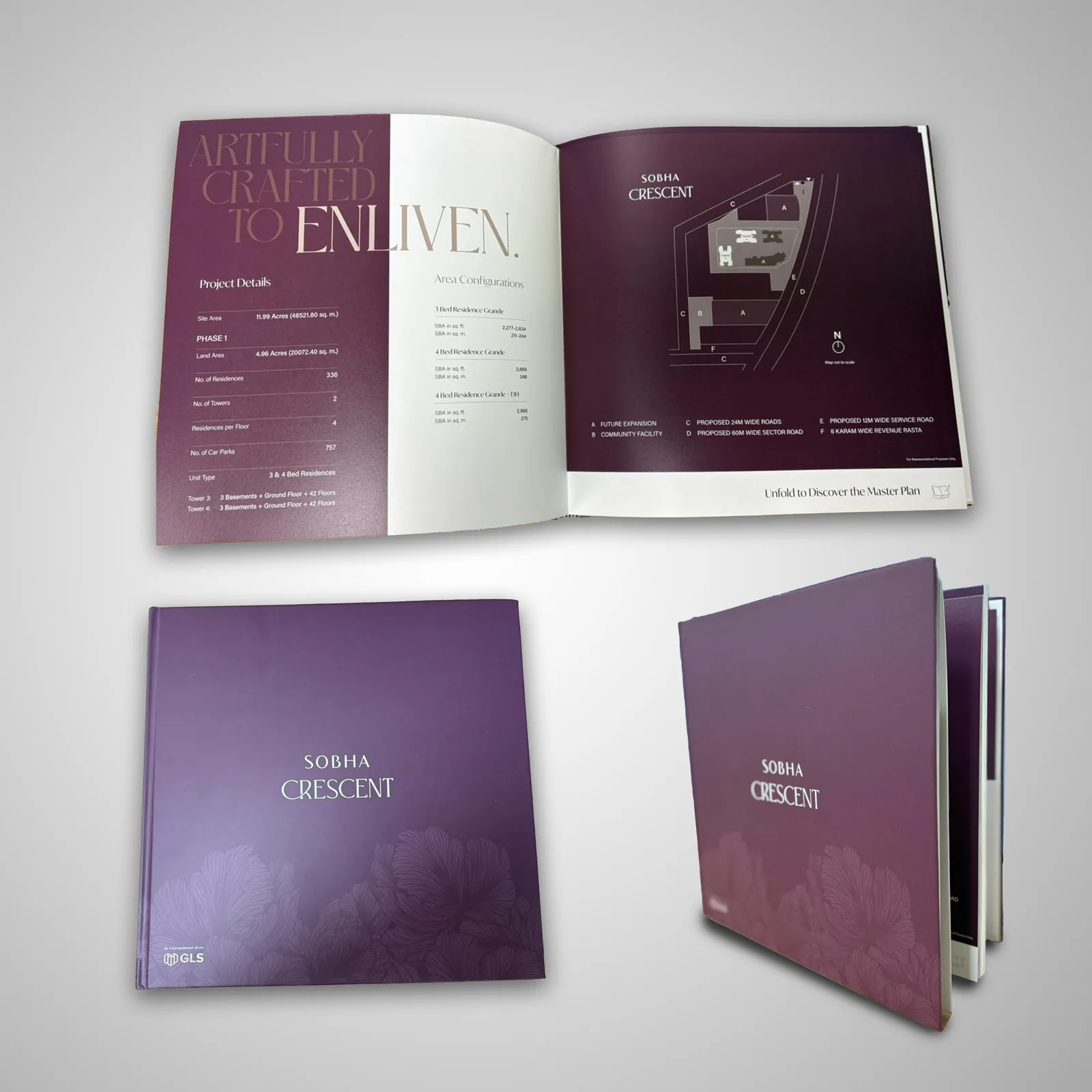
| Real estate project brochure | Is this property right for my family? | Location map, configurations and floor plans, amenities, specifications, approvals, site-visit contact |
| Product brochure or leaflet | Does this product fit my need? | Features against use cases, technical specs, sizes or variants, how to order |
| Company profile | Can this partner deliver for us? | Capabilities, industries served, process, named clients with permission, contact |
| Exhibition handout | Should I follow up after the event? | One clear offer, the key specs, a QR code to a page specific to the event |
Can a brochure have too much information?
Yes. Putting every product, service and milestone into one brochure makes the useful parts harder to find. The fix is organisation, not cutting: group related content, put specifications in tables, give each spread one job, and use headings a reader can scan in seconds. If the content genuinely splits by audience, two focused brochures usually work better than one that tries to serve everyone.
Does print quality affect whether a brochure is kept?
Key Takeaway
It affects whether the brochure can be used. Tiny type, crowded pages or muddy photographs make good content hard to read.
A short product leaflet and a premium project brochure need different specifications, so choose for the job rather than paying for finishes the reader will never notice. The practical choices are paper, format and finish.
Related: Paper GSM guide · Brochure paper weight · Spot UV vs matte vs soft-touch
- Paper: coated silk or matte stocks reproduce photography sharply without the glare of gloss. Inner pages of 130–170 GSM and a heavier 250–350 GSM cover are common for brochures that are handled often.
- Format: an A4 sheet folded twice (a tri-fold) gives a DL leaflet of 99 × 210 mm that fits a jacket pocket or an envelope. Multi-page brochures are usually saddle stitched, which needs a page count divisible by four.
- Finish: lamination protects a cover that will be handled for weeks. Foil or embossing are worth it where the brochure itself carries a premium message, such as a luxury property launch.
How do you know if a brochure is working?
Print quantity tells you what went out, not what it did. Better signals come from use. Reprint with the pages that get used, and cut the ones that don't.
- Put a QR code or short link specific to the campaign on the brochure, and count the visits and enquiries it brings.
- Ask the sales team which pages they actually open in meetings.
- Ask customers what they looked up in it afterwards.
What should you decide before brochure design starts?
Key Takeaway
Five things: the reader, what they will look up again, where they will receive it, how long it must last, and the single action it should lead to.
With these answered, layout, paper and finishing decisions get much easier. RoboSouls handles brochure design and printing together, with offset printing and all finishing in-house in Delhi NCR and delivery across India.
Related: How to brief a printer · Request a quote
- Who is the reader, and what decision are they making?
- What will they need to look up again?
- Where will they receive it: in a meeting, at an exhibition, by post?
- How long must it last in use?
- What single action should it lead to?
Summary Overview
A brochure doesn't need the most expensive paper or the most elaborate design to work. It needs to give the reader something they will want to check again, laid out so they can find it. Plan that content first, then choose the format, paper and finish that serve it. The question to start with is simple: what would make someone want to keep this?
Frequently asked questions
Why do some brochures get kept while others are thrown away?
Brochures get kept when they contain information the reader expects to need again, such as specifications, floor plans, product codes or contact details. Brochures that mostly describe the company, or are hard to read, get thrown away.
What should a business include in a brochure?
Whatever the reader needs for their next decision. For a product, that is specifications and variants. For a property, it is location, floor plans and amenities. For a company profile, it is capabilities, process and contact details.
Which paper is best for brochure printing?
For most brochures, a coated silk or matte stock of 130–170 GSM for inner pages and 250–350 GSM for the cover. Gloss gives the strongest colour but reflects light. Uncoated stock suits text-heavy or writable pieces.
What is the standard brochure size in India?
A4 (210 × 297 mm) and A5 (148 × 210 mm) under ISO 216, and the DL tri-fold (99 × 210 mm), which is an A4 sheet folded twice.
How can a business measure whether its brochure works?
Use a QR code or link that is unique to the campaign, ask the sales team which pages they use, and ask customers what they referred to later.
Sources
Technical Consultation
Need specific specifications for your project?
Send us the format, quantity and finish you are considering, and we will come back with a specification and a quote. Lead time is confirmed with the quote.