
Understanding Paper GSM: A Practical Guide to Choosing the Right Paper Weight
Ektta Jain
Founder, RoboSouls •
Executive Summary
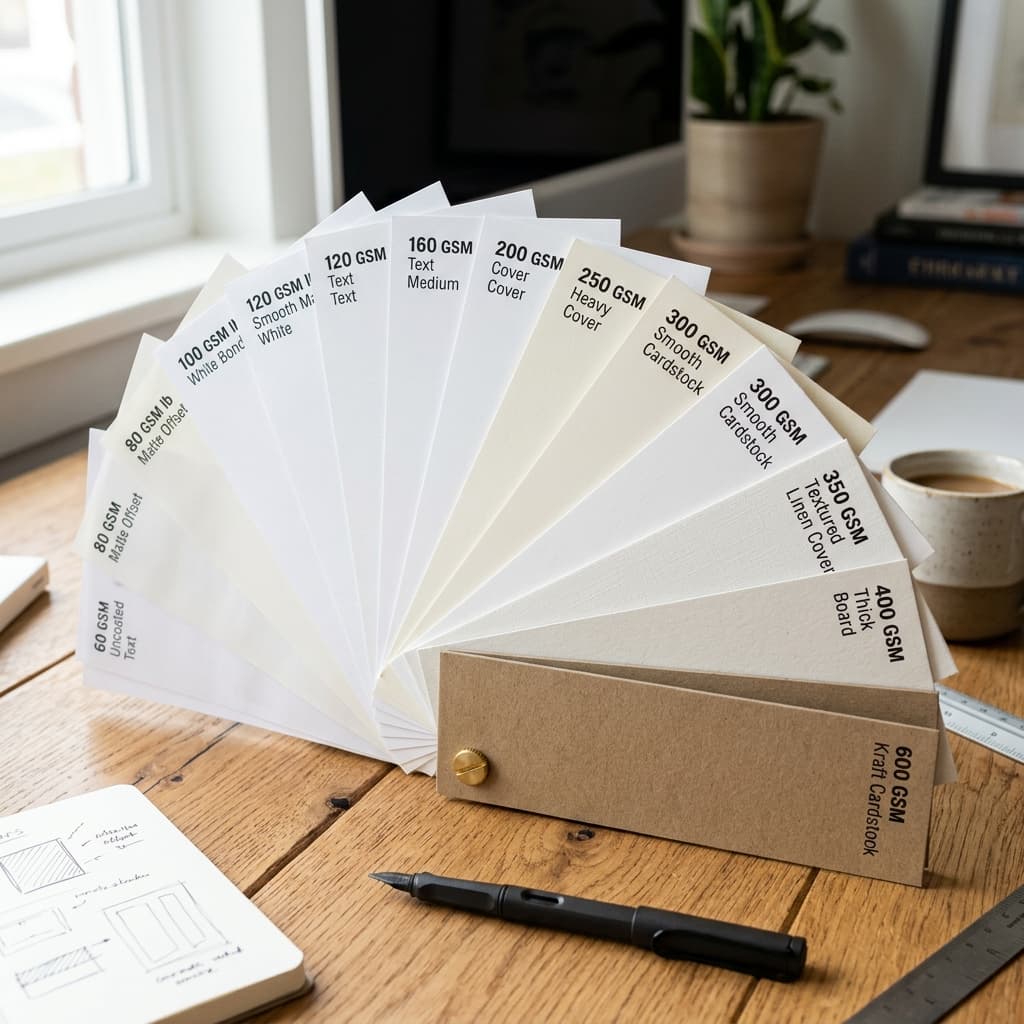
GSM means grams per square metre: the weight of a single sheet of that paper measured at one metre by one metre. It describes mass, not thickness. As a working guide, 70–100 GSM suits letterheads and book text, 130–170 GSM suits brochure and catalogue inner pages, 250–350 GSM suits covers and business cards, and 300–450 GSM board suits folding cartons. Rigid boxes are different again: they use a greyboard core measured in millimetres, wrapped in a 120–170 GSM printed sheet.
Key takeaways
- GSM measures weight per square metre, not thickness. Two papers at the same GSM can differ noticeably in calliper.
- Bulky uncoated stocks feel thicker than coated stocks of identical GSM, because coating adds weight without adding much height.
- Opacity, not GSM alone, decides whether print shows through from the reverse side.
- Above roughly 170 GSM, paper must be creased before it is folded or the fibres will crack along the fold.
- Rigid box thickness is quoted in millimetres of greyboard, not GSM. The GSM figure refers only to the wrap sheet.
1. What GSM Actually Measures
Key Takeaway
GSM is grams per square metre: cut a sheet of the paper to exactly one metre square and weigh it. 300 GSM paper means that sheet weighs 300 grams.
GSM is a measure of mass per unit area, and that is all it is. It says nothing directly about how thick a sheet feels, how stiff it is, or how opaque it is. This matters because buyers routinely use GSM as shorthand for thickness, and then get a result that does not match what they pictured. A 300 GSM coated art card and a 300 GSM uncoated textured card weigh the same, but the uncoated sheet will usually be visibly and tangibly thicker, because the mineral coating on the art card adds weight without adding much height. If the physical thickness of the sheet is what matters to your design, the number to ask for is calliper, quoted in microns, not GSM.
2. GSM, Calliper and Bulk: Three Different Numbers
Three properties get conflated in print briefs, and separating them removes most of the confusion. GSM is weight. Calliper is thickness, measured in microns, and is what determines whether a business card feels substantial between finger and thumb. Bulk is the relationship between the two — a high-bulk paper achieves more thickness for the same weight, which is why some paperback novels feel chunky despite using light stock. When you are specifying a job, decide which of the three actually matters. For a mailed brochure where postage is a real cost, GSM is the number to control. For a business card where the tactile impression is the entire point, calliper is what you should be asking about.
| Property | What it measures | Unit | When it is the number that matters |
|---|---|---|---|
| GSM | Weight of one square metre of the sheet | g/m² | Postage, freight, and press compatibility |
| Calliper | Physical thickness of the sheet | Microns (µm) | Perceived quality, stiffness, card feel |
| Bulk | Thickness achieved per unit of weight | cm³/g | Book spine width, catalogue thickness |
| Opacity | How much light passes through | Percentage | Double-sided printing, show-through |
3. A Working GSM Guide by Application
Key Takeaway
70–100 GSM for letterheads and book text. 130–170 GSM for brochure and catalogue inners. 250–350 GSM for covers and business cards. 300–450 GSM board for folding cartons.
These are the conventional ranges used across commercial printing. They are starting points for a conversation, not rules — a heavier stock is not automatically a better one, and specifying 400 GSM where 300 GSM would do adds cost and freight without adding perceived quality. Note that folding cartons and rigid boxes sit in a different category from paper: cartons are cut from paperboard specified in GSM, while rigid boxes use a greyboard core specified in millimetres.
| Application | Typical range | Notes |
|---|---|---|
| Letterheads, forms, NCR sets | 70–100 GSM | Must run through office printers and photocopiers |
| Book and magazine text pages | 70–130 GSM | Opacity matters more than weight at this end |
| Brochure and catalogue inner pages | 130–170 GSM | 170 GSM is the common premium default |
| Brochure and catalogue covers | 250–350 GSM | Needs creasing before folding |
| Business cards | 300–400 GSM | Below 300 GSM reads as flimsy in the hand |
| Presentation folders | 300–400 GSM | Stiffness carries the weight of inserts |
| Postcards and invitations | 250–350 GSM | Check postal thickness limits before finalising |
| Folding cartons and monocartons | 300–450 GSM board | Structure depends on board grade as much as weight |
| Rigid box wrap sheet | 120–170 GSM | Must wrap a corner without cracking |
4. Coated, Uncoated and Textured: Why the Same GSM Feels Different
Coating changes almost everything about how a given GSM behaves. A coated art paper has a mineral layer applied to the surface, which holds ink on top of the sheet rather than letting it sink in. That produces sharper images and stronger colour, and it is why photography-led catalogues are almost always printed on coated stock. Uncoated papers absorb ink into the fibre, which softens the image slightly and shifts colours a little duller, but they take a pen and feel warmer to the touch. Textured and laid papers add a further variable: the surface relief scatters light and can break up fine detail, so small type and hairline rules need care. When comparing quotes, make sure you are comparing the same surface as well as the same weight.
- Coated gloss: highest ink holdout and colour saturation, most reflective, can be tiring to read at length.
- Coated matte and silk: same colour strength as gloss with far less glare, the usual choice for text-heavy premium work.
- Uncoated: writable, warmer, softer image, needs a heavier weight to achieve the same perceived substance.
- Textured and laid: distinctive hand-feel, but avoid for fine serif type and dense photographic detail.
5. Folding, Creasing and the Cracking Threshold
Key Takeaway
Above roughly 170 GSM, paper needs a crease before folding. Skip that step and the fibres split along the fold, which is most visible on dark, heavily inked covers.
Creasing is a mechanical operation that compresses the fibres along a line so the sheet folds cleanly instead of tearing. On lighter stock the fibres can absorb a fold without help. Past roughly 170 GSM they cannot, and the result is the ragged white line along a spine that makes an expensive brochure look cheap. The problem is worse on coated stock, because the coating layer has no give at all, and worse again on dark covers, where any exposed white fibre is obvious. If a job has a heavy coated cover in a dark colour, laminating before folding is the usual insurance: the film holds the surface fibres together across the fold. This is one of the most common causes of avoidable disappointment in brochure printing, and it is entirely preventable at the specification stage.
6. Opacity and Show-Through on Double-Sided Work
Opacity is measured as a percentage and describes how much light passes through a sheet. It is a separate property from GSM, though the two correlate loosely. For double-sided printing, opacity is the number that decides whether the reverse side ghosts through and makes the page harder to read. Heavy solid blocks of colour show through far more than text, so a design with full-bleed dark panels on both sides of the same leaf needs more opacity than a text-only document at the same weight. If a catalogue design puts photography on both sides of every page, discuss opacity explicitly rather than simply raising the GSM, because a bulkier sheet at the same opacity will not solve it.
7. How GSM Interacts with Cost and Freight
Paper is typically the largest single material input in a print job, and it is bought by weight. Moving a 5,000-copy catalogue from 130 GSM to 170 GSM inners raises the paper weight of the job by roughly a third, and that increase flows through both the material cost and the freight cost of delivering the finished cartons. This is worth modelling before the specification is frozen, particularly for anything being shipped across the country or mailed individually. The practical advice is to put the weight where it will be felt: a heavier cover with lighter inners usually delivers more perceived quality per rupee than raising every page uniformly.
Summary Overview
GSM is the most quoted number in a print brief and the most frequently misread. Treat it as one of four related properties — weight, thickness, bulk and opacity — and specify against the one that actually governs your job. Put the heavier stock where a reader will physically handle it, keep the inners lighter unless opacity demands otherwise, and crease anything above 170 GSM before it is folded.
Frequently asked questions
What does GSM mean in printing?
GSM stands for grams per square metre. It is the weight of a sheet of that paper measured at one metre by one metre. A 300 GSM sheet cut to that size weighs 300 grams. It describes weight, not thickness.
Is higher GSM always better quality?
No. GSM should match the application. A letterhead at 350 GSM will not feed through an office printer, and a mailed brochure on unnecessarily heavy stock costs more to produce and post without reading as better made. Quality comes from choosing the right weight, surface and finish together.
What GSM should a business card be?
Most premium business cards fall between 300 and 400 GSM. Below 300 GSM a card tends to feel flimsy in the hand. Above 400 GSM the card becomes difficult to cut cleanly and may not fit standard cardholders. Duplexed cards, where two sheets are bonded together, go heavier still.
What is the difference between GSM and calliper?
GSM is weight per square metre and calliper is physical thickness in microns. Two papers can share a GSM figure and differ noticeably in calliper, because coating adds weight without adding much height. If the tactile thickness of the sheet is what matters, ask for calliper.
Why does my brochure cover crack along the fold?
Because it was folded without being creased first. Above roughly 170 GSM the fibres cannot absorb a fold and split along the line. Creasing compresses the fibres so they fold cleanly. On dark, heavily inked coated covers, laminating before folding gives further protection.
What GSM is used for rigid boxes?
Rigid boxes are not specified in GSM for their structure. The core is greyboard, quoted in millimetres of thickness. GSM applies only to the printed wrap sheet that is laminated over that core, which typically falls between 120 and 170 GSM so it can turn a corner without cracking.
Technical Consultation
Need specific specifications for your project?
Send us the format, quantity and finish you are considering, and we will come back with a specification and a quote. Production runs to a 72 hour turnaround.