
Offset Printing vs Digital Printing: When to Choose Which
Ektta Jain
Founder, RoboSouls •
Executive Summary
Offset printing transfers ink from plates to a rubber blanket to the sheet, and carries a fixed setup cost for platemaking that is then spread across the run. Digital printing images each sheet directly with no plates and no setup, so every copy costs roughly the same. The result is a crossover point: below it digital is cheaper, above it offset is, and the position of that point moves with sheet size, colour count and finishing. Offset also holds the advantage on large sheets, spot and metallic inks, wide substrate range and colour consistency across a long run.
Key takeaways
- Offset carries a setup cost that digital does not, so offset gets cheaper per unit as the run grows while digital stays roughly flat.
- There is a crossover quantity where the two meet. It moves with sheet size, number of colours and finishing, so it has to be worked out per job.
- Offset can print Pantone spot colours, metallics and opaque whites as actual inks. Digital simulates them from process colours.
- Digital wins on short runs, variable data, and jobs that need reprinting in small quantities.
- At RoboSouls offset is in-house; digital, screen, UV and large format are outsourced to partner presses.
1. How the Two Processes Actually Work
Key Takeaway
Offset makes a physical plate per colour and transfers ink via a rubber blanket onto the sheet. Digital images each sheet directly from the file, with no plate in between.
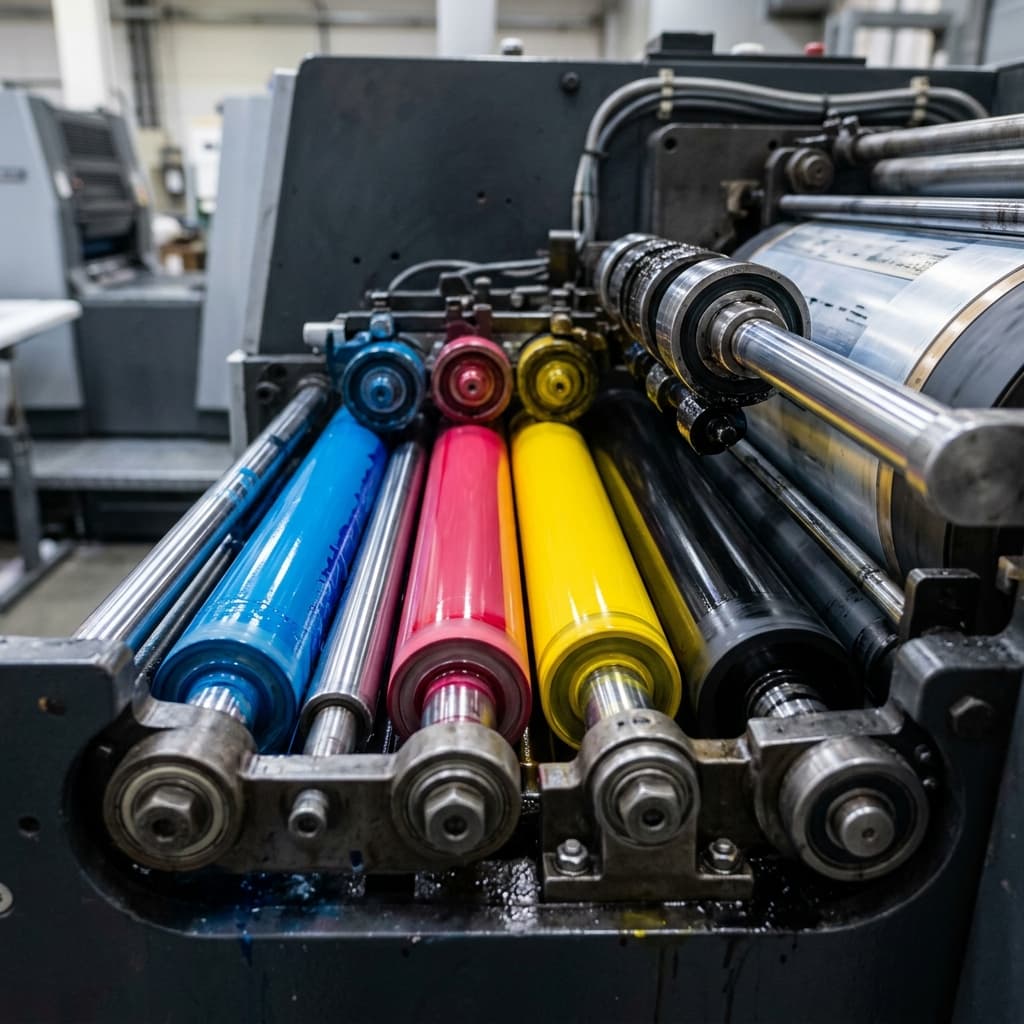
In offset lithography, each colour in the job is burned onto its own aluminium plate. The plate carries ink only where the image sits, transfers that ink to a rubber blanket cylinder, and the blanket lays it onto the paper. The indirect route through the blanket is what the word offset refers to, and it is why the process handles textured and uneven stocks so well. Digital presses skip plates entirely: a toner-based press fuses particles onto the sheet under heat, and an inkjet press sprays droplets directly. Because there is nothing to make before the first sheet, a digital press can start printing immediately, and every sheet in the run can carry different content. Those two mechanical differences drive almost every practical distinction that follows.
2. The Crossover Point: Where Offset Overtakes Digital
Key Takeaway
Offset has a fixed setup cost and a low cost per sheet. Digital has no setup and a higher cost per sheet. Plot both and they cross at a quantity that is specific to the job.
This is the single most useful mental model for the decision. An offset job pays for plates, make-ready and press wash-up before a single saleable sheet comes off. Once running, each additional sheet is inexpensive. A digital job pays nothing up front but roughly the same amount for the thousandth sheet as for the first. Draw those two lines and they intersect. Below the intersection, digital is the cheaper answer. Above it, offset is, and the gap widens quickly. What matters is that the intersection is not a fixed number you can memorise. It moves with how many colours the job uses, how large the sheet is, how many pieces fit on that sheet, and what finishing follows. A single-colour job on a small sheet crosses over at a very different quantity from a five-colour job with a spot varnish. Ask for both routes to be quoted when your quantity is anywhere near the boundary.
| Factor | Pushes the crossover point down (favours offset sooner) | Pushes it up (favours digital longer) |
|---|---|---|
| Quantity | Higher quantities | Low quantities |
| Sheet size | Large sheets with high piece yield | Small sheets, few pieces per sheet |
| Colour count | Fewer colours, so fewer plates | Many colours or full CMYK plus spots |
| Reprint pattern | One large run | Frequent small top-ups |
| Content | Identical on every copy | Personalised or versioned per copy |
| Substrate | Textured, heavy or unusual stocks | Standard coated stocks |
3. Colour: Where Offset Still Has a Real Edge
Digital colour has improved enormously and for most photographic work the difference is no longer visible to a client. Where offset retains a genuine advantage is in colour that sits outside the process gamut. A Pantone spot colour on an offset press is a physically mixed ink, laid down as itself. On a digital press it is simulated by combining process colours, and some Pantones simply cannot be reached that way — bright oranges, deep blues and most greens are the usual casualties. If your brand colour is one of those, the difference is not subtle and it will be obvious against your existing collateral. The same applies to metallic inks and opaque white, which exist as real inks in offset and only as approximations, if at all, in most digital workflows. Long-run consistency is the other consideration: a well-managed offset run holds colour tightly from first sheet to last, which matters when the pieces will sit next to each other on a shelf or in a kit.
- Brand-critical Pantone: specify offset, or accept a proof-approved process simulation.
- Metallic gold or silver as ink: offset, or use foil stamping as a separate finishing pass.
- Opaque white on coloured or kraft stock: offset or screen, not standard digital.
- Photographic CMYK with no spot requirement: either process will serve.
4. Substrate Range and Sheet Size
Key Takeaway
Offset handles a far wider range of stocks, including heavy board and textured papers, and runs on larger sheets. RoboSouls prints offset to a maximum sheet of 28 x 40 inches.
Because offset lays ink via a compliant rubber blanket rather than fusing it under heat or spraying it from a fixed head, it copes with surfaces digital presses struggle with. Textured, laid and heavily embossed stocks take offset ink well. Very heavy board runs through offset routinely. Toner-based digital presses have tighter limits on both weight and texture, and heat fusing can cause problems on some coated and synthetic stocks. Sheet size is the other structural difference. A large offset sheet lets a printer impose many pieces at once, which is where much of the economy of a long run actually comes from. The maximum sheet at our Naraina press is 28 x 40 inches, and the number of pieces that fit on that sheet is often the hidden variable that decides whether a quantity is economical.
5. Turnaround and the Reprint Problem
Digital is faster to start and slower to scale; offset is slower to start and much faster to scale. For a hundred copies needed tomorrow, digital will almost always win, because there is no platemaking step and no make-ready. For ten thousand copies, the offset press will have finished long before a digital press has worked through the same volume. The reprint pattern is worth thinking about separately. If a catalogue is likely to need small top-ups every few weeks because product lines change, a long offset run risks being obsoleted in the warehouse, and repeated short digital runs may cost less overall even at a higher unit rate. If the content is stable, the opposite is true. Production at RoboSouls runs to a 72 hour turnaround; where a job needs to move faster than that, it is handled case by case.
6. Variable Data: The Job Offset Cannot Do
There is one category where the choice is not a trade-off at all. If every copy needs to be different — personalised names, sequential numbering, unique QR or barcodes, region-specific versions — offset cannot do it without making new plates for each variant. Digital handles it natively, because each sheet is imaged independently from the file. Employee ID cards, numbered certificates, individually addressed direct mail and serialised authenticity labels all belong on digital regardless of quantity. Conversely, some hybrid jobs make sense: printing the static shell offset for the economics, then overprinting the variable element digitally as a second pass.
7. A Decision Framework
Key Takeaway
Ask four questions in order: does every copy differ, is a brand-critical spot colour involved, is the substrate unusual, and is the quantity above the crossover point?
Working through the decision in a fixed order avoids most mistakes, because the first three questions can settle the answer on their own before quantity is even considered. Variable content forces digital. A brand-critical Pantone, a metallic, or an opaque white on coloured stock pushes strongly toward offset. An unusual or very heavy substrate does the same. Only when none of those apply does the decision reduce to quantity and unit economics, and at that point the honest answer is to have the job quoted both ways rather than guessing. Any printer who cannot show you the comparison for your specific quantity, sheet size and colour count is guessing too.
- Does every copy need to be different? If yes, digital.
- Is a Pantone, metallic or opaque white brand-critical? If yes, offset or a finishing pass.
- Is the substrate textured, very heavy or unusual? If yes, offset.
- If none of the above, quote both and compare at your actual quantity.
Summary Overview
Offset and digital are not competing qualities, they are different cost structures. Digital removes setup and charges steadily per sheet; offset front-loads setup and then produces cheaply at volume. Decide on content, colour and substrate first, because any one of those can settle the question outright. Only when none of them applies does the choice come down to quantity, and at that point the right move is to have the job priced both ways rather than assume.
Frequently asked questions
Is offset printing cheaper than digital?
It depends entirely on quantity. Offset carries a setup cost for plates and make-ready that digital does not, so offset is more expensive for small runs and progressively cheaper as the run grows. There is a crossover quantity specific to each job, determined by sheet size, colour count and finishing.
At what quantity should I switch from digital to offset?
There is no universal number. The crossover moves with how many pieces fit on the press sheet, how many colours the job uses and what finishing follows. A single-colour job crosses over at a very different quantity from a five-colour job. Ask for the job to be quoted both ways.
Can digital printing match Pantone colours?
It can approximate most of them by combining process colours, but some Pantones sit outside the achievable range — bright oranges, deep blues and many greens in particular. Offset prints a Pantone as a physically mixed ink, so it reproduces exactly. If the colour is brand-critical, that difference is visible.
Which is better for a 500-copy brochure?
500 copies sits close to the crossover for many brochure specifications, which makes it exactly the quantity worth quoting both ways. The deciding factors are usually the number of colours, whether a spot colour is involved, and what finishing the cover needs.
Does RoboSouls print offset in-house?
Yes. Offset printing runs in-house at our Naraina Industrial Area facility, to a maximum sheet size of 28 x 40 inches. Digital, screen, UV and large format printing are outsourced to partner presses.
What is the maximum sheet size for offset printing at RoboSouls?
28 x 40 inches. Sheet size matters because it determines how many finished pieces can be imposed on a single press sheet, which is often the hidden factor in whether a given quantity is economical.
Technical Consultation
Need specific specifications for your project?
Send us the format, quantity and finish you are considering, and we will come back with a specification and a quote. Production runs to a 72 hour turnaround.